‘I did not move it’
Without user, date and origin, the conversation depends on memory instead of evidence.
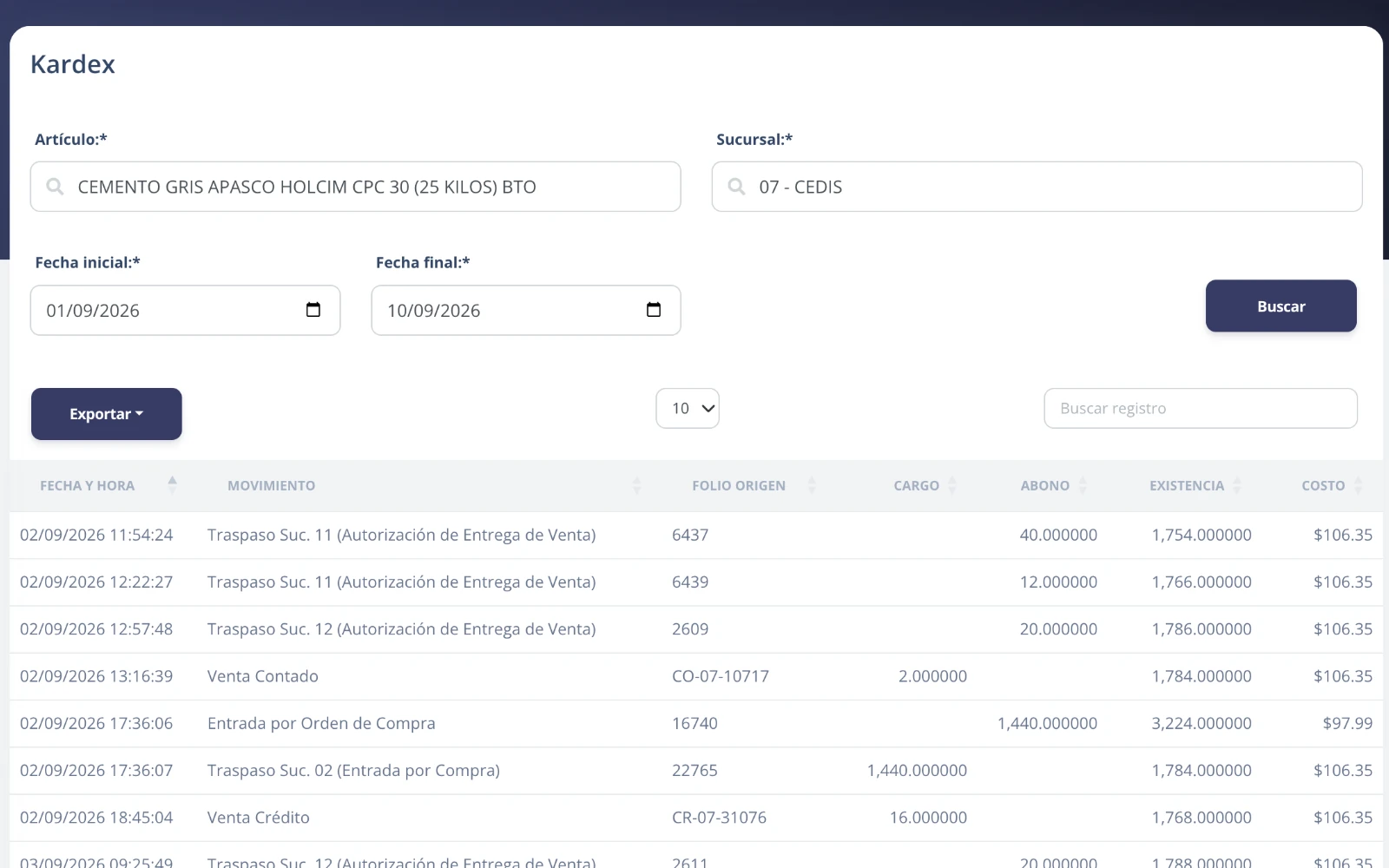
Metrify does not stop at current stock. It keeps movements, branch, user, date and origin to help explain how an item reached the quantity you see today.
Sales, purchasing, transfers, adjustments and branches change stock all day. When context is missing, every difference becomes a human investigation.
Without user, date and origin, the conversation depends on memory instead of evidence.
Stock by location needs to be available to sales without calling warehouse after warehouse.
Receiving merchandise and recording it should be part of the same story to prevent later differences.
Correcting the number without understanding the cause can hide the problem that created it.
Explainable inventory
Metrify connects movements with the operation that caused them so inventory becomes a sequence of facts, not just a final number.
Each location keeps its own stock and movements without losing the global view.
Sales, purchases, adjustments and transfers can preserve context for later investigation.
Working backward from stock
Current quantity
What the system shows today.
Movements
Which entries and exits changed the balance.
Context
User, branch, date and type of operation.
Origin
Sale, purchase, adjustment, transfer or another related operation.
Real history
Each movement keeps its date, branch, type and origin so stock can be explained, not only checked.
Inventory control for hardware stores
As the catalog and branch network grow, inventory control means being able to find, move, receive and explain merchandise without depending on memory.
The counter needs an answer, not an investigation.
Metrify keeps inventory by location so sales can see where an item exists and how much is available without mixing warehouses.
This is especially useful in hardware and building-material distributors, where the same product can be spread across several branches and the sales opportunity depends on finding it quickly.
An exit without origin only changes the number.
Traceability aims to preserve who made a movement, in which branch, when it happened and which operation caused it. When physical inventory does not match the system, that history narrows the search.
It also protects the user when the work was done correctly: evidence is useful not only for finding errors, but also for showing what actually happened.
Recording a purchase should not mean retyping the invoice.
In Metrify, some purchasing flows can start from the supplier XML. Instead of entering every line, the person reviews the information and approves the receipt.
For large invoices, that difference can turn hours of re-entry into minutes of validation and reduce errors before they reach inventory.
From a difference to an explanation
In the real operation, rebuilding what happened when stock did not match was difficult. The product evolved to preserve more and more context around each movement.
The goal is for an inventory difference to start with evidence instead of a round of questions.
Where the movement happened.
Who executed the operation.
Which sale, purchase or adjustment caused it.
When the quantity changed.
Connected inventory
Follow the operations that affect inventory most.
Inventory
Inventory
Movements, users, branches and origin before the next adjustment.
Inventory
Stock by location without running the business through messages.
Purchasing
Use the supplier invoice as the starting point instead of a re-entry task.
For operations with many items and multiple locations.
Yes. Each location can keep its own stock and movements while maintaining a global view of the operation.
Metrify traceability aims to preserve movements, user, branch, date and originating operation so inventory changes can be reconstructed.
Yes. Some flows can start from the supplier invoice XML for review and approval instead of re-entering every item.
Yes. Sales can check and affect stock while keeping branch and operation context.
Bring the spreadsheet, exception or process that still depends on calls, memory or repeated data entry. Start there.