Every department has its own version
Sales, warehouse and administration can look at the same operation through different files or reports.
Metrify connects sales, inventory, purchasing, credit, branches, invoicing and metrics for distributors where growth has made ‘ask someone’ an insufficient operating model.
You do not need a thousand employees. A few branches, a large inventory, credit, salespeople and exceptions are enough for processes to start crossing each other.
Sales, warehouse and administration can look at the same operation through different files or reports.
When applying a rule requires knowing a historical exception, part of the ERP lives in people's heads.
More branches add stock, users, permissions, transfers, targets and receivables that still need to remain comparable.
If the P&L or KPI arrives after the period, it can no longer help correct the course while things are happening.
Software for a connected operation
Metrify preserves relationships between operations so sales, inventory, purchasing, credit and fiscal processes can follow the same story.
The product is evolving to separate core best practices from the rules that make each company different.
User, branch, movement and operation help explain what happened when something turns out differently.
The commercial core
Sell
customers, terms, prices, branch and payment.
Move
inventory, receipts, issues, adjustments and transfers.
Collect
credit, payments, advances, due dates and balance.
Understand
metrics, targets, categories and performance.
Complete operation
Sales, inventory, receivables and metrics share context so a question can be followed from beginning to end without rebuilding the story by hand.
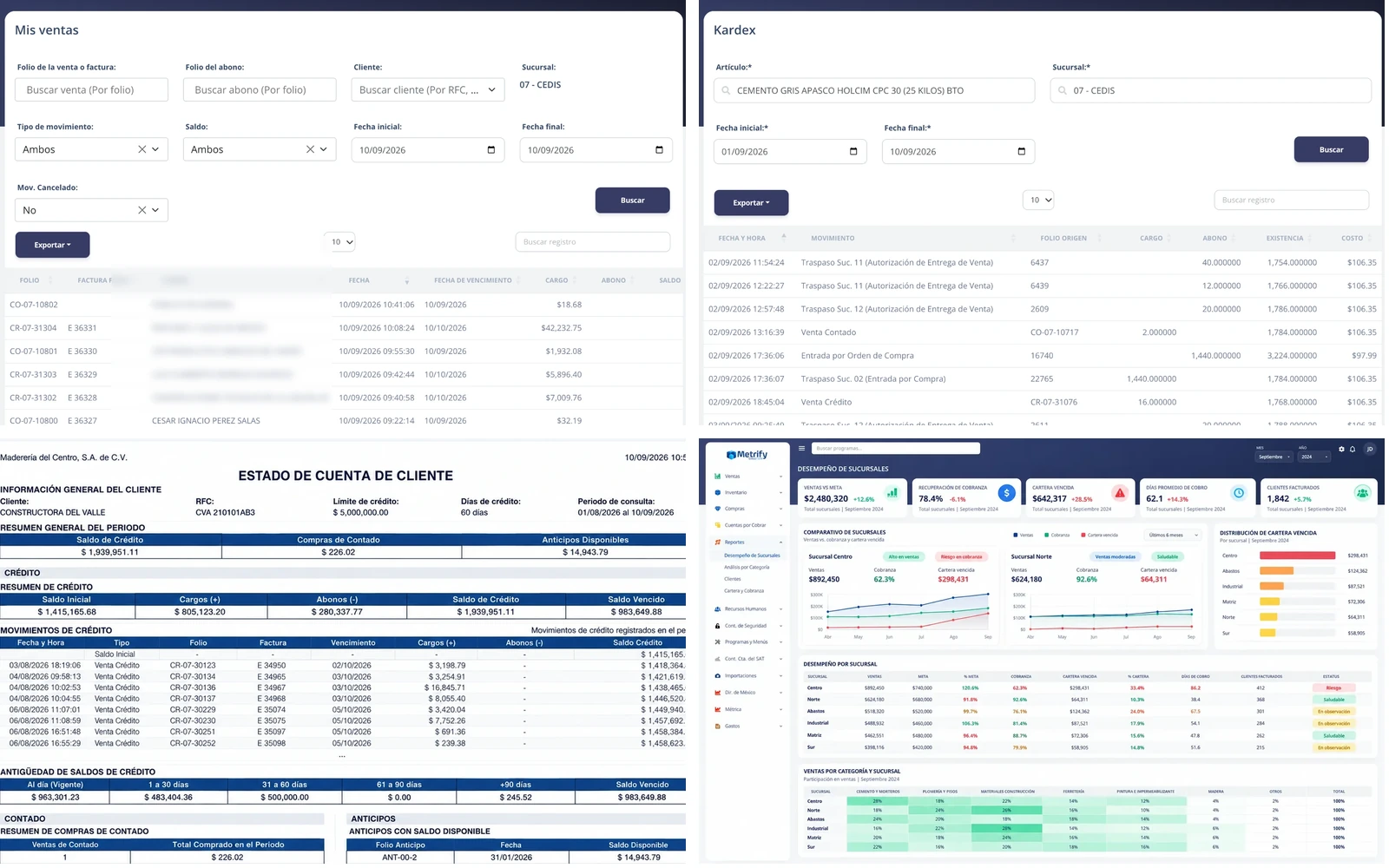
ERP for distribution and commercial operations
In a distributor, one sale can affect inventory, credit, cash, fiscal documents, targets and results. The value appears when the system preserves those consequences.
The customer should not wait while someone remembers the rule.
Prices, discounts, credit, balances, approvals and history change how a sale can be closed. Metrify aims to bring that context into the commercial flow so the salesperson makes simple decisions with complex rules underneath.
With multiple branches, the same sale also needs to check stock by location and preserve where it happened.
What arrives from the supplier should become inventory without starting from zero.
Metrify can start from a supplier invoice XML to review and approve a purchase, reducing item-by-item entry. The merchandise receipt then remains related to inventory and the context of the operation.
This kind of automation matters especially as the catalog grows and one invoice can contain dozens or hundreds of lines.
Placing credit and recovering money are two different results.
Sales, payments, advances, credit notes, adjustments and due dates can make up a customer's balance. Metrify aims for the account statement to explain that balance without parallel reconstruction.
Management can combine this information with sales and targets to avoid rewarding volume alone while receivables deteriorate.
Learned inside a distributor
Construalianza grew until its previous system left gaps around inventory, purchasing, sales, invoicing and metrics. Metrify was built inside that operation.
The challenge now is turning that accumulated knowledge into a configurable product for more companies without turning it into custom development.
The product already lives inside a distributed operation.
Different roles working on the same operational base.
XML, review and approval instead of item-by-item re-entry.
Commercial rules converted into operating measurements.
Where to start
Metrify makes more sense when you follow one real problem from beginning to end.
Before choosing an ERP
ERP
Better questions than a table full of checkmarks.
ERP
Find rules and processes the system still has not absorbed.
Purchasing
Reduce re-entry when a supplier invoice contains dozens of lines.
For companies where selling, fulfilling, purchasing and collecting already depend on each other.
Yes. Its strongest fit today is distributors with inventory, branches, salespeople, credit, purchasing, invoicing and operating rules that cross departments.
Metrify operates in a multi-branch environment and preserves stock, movements, users and metrics with location context.
Yes. It can connect sales, payments, advances, credit notes, due dates and balances to build receivables and account statements.
Yes. Metrify manages suppliers, receipts, costs and movements. Some purchasing flows can start from XML to reduce re-entry.
Metrify contains important financial and fiscal information, but it is not currently positioned as a full accounting suite comparable to specialized accounting software.
Bring the spreadsheet, exception or process that still depends on calls, memory or repeated data entry. Start there.